
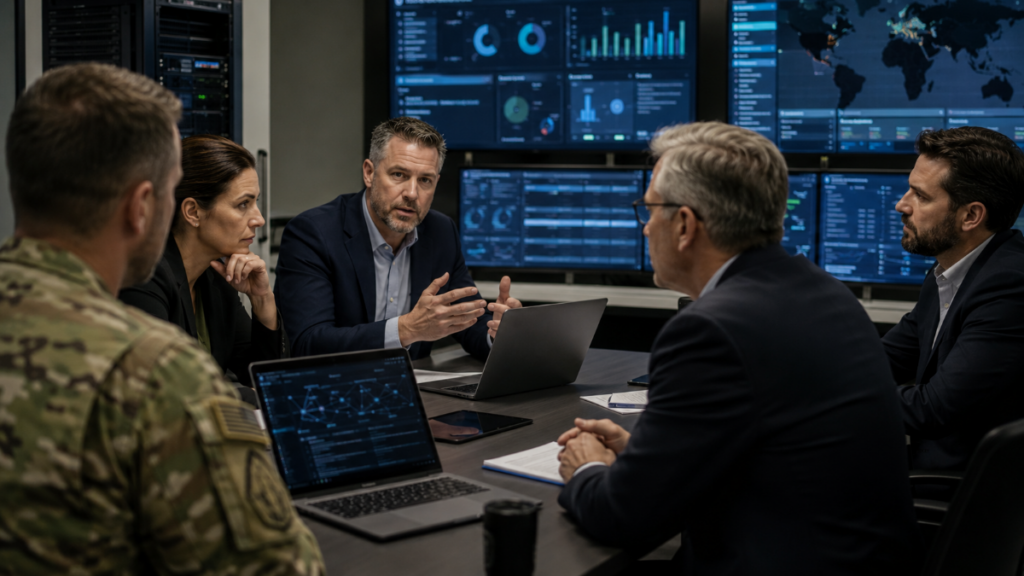
Most defense contractors pursuing CMMC certification approach it as a project with a start date and an end date. They assign someone to manage the process, work through the requirements, and expect to check the certification box when the assessment is complete. What they discover along the way is that CMMC compliance is not a project at all. It is an ongoing operational state that requires continuous monitoring, regular updates, annual affirmations, and a security posture that is maintained consistently over time, not just verified once.
That distinction changes how smart organizations approach certification from the beginning. Instead of treating CMMC compliance as something to achieve and then hand back to an already stretched internal team, the organizations that sustain compliance most effectively build it on a foundation of managed IT services that deliver the continuous capabilities the framework actually demands.
Quick Summary
-
CMMC compliance requires ongoing monitoring, continuous maintenance, and annual affirmations that internal teams without dedicated cybersecurity resources struggle to sustain
-
Managed IT services provide the 24/7 monitoring, system management, and documentation support that CMMC demands on a continuous basis
-
Organizations that build their CMMC program on a managed services foundation reach certification faster, maintain it more reliably, and spend less over time than those relying solely on internal resources
-
The right managed IT partner brings both the technical capabilities and the compliance expertise that certification requires
Table of Contents
-
Why CMMC Is an Ongoing Commitment, Not a One-Time Achievement
-
What Most Internal IT Teams Cannot Sustain Alone
-
How Managed IT Services Directly Support CMMC Requirements
-
The Cost Comparison: Internal Resources Versus Managed Services
-
What to Look for in a Managed IT Partner for CMMC Compliance
-
How Mindcore Technologies Delivers Both Managed IT and CMMC Expertise
-
Build Your Compliance on a Foundation That Lasts
Why CMMC Is an Ongoing Commitment, Not a One-Time Achievement
Achieving CMMC certification is a milestone, but it is not a destination. The framework requires that certified organizations maintain their compliance posture continuously across the period of their certification, submit annual affirmations confirming ongoing compliance, and undergo reassessment every three years.
Those requirements have operational implications that many contractors do not fully account for during the initial preparation phase. Maintaining compliance means keeping access controls current as staff and roles change. It means ensuring that monitoring systems are functioning and that alerts are being reviewed and acted upon every day, not just during an assessment window. It means updating documentation when systems change, reviewing vendor access regularly, delivering security awareness training on a scheduled basis, and keeping incident response procedures current and tested.
For organizations without dedicated cybersecurity staff, sustaining all of that alongside the demands of running a business is genuinely difficult. The contractors who struggle most with CMMC are not the ones who fail to achieve certification initially. They are the ones who achieve it and then watch their compliance posture erode over the months that follow because they did not build a sustainable operational structure around it from the start.
What Most Internal IT Teams Cannot Sustain Alone
The cybersecurity requirements embedded in CMMC Level 2 were written for organizations with mature security operations. They assume continuous system monitoring, prompt incident response, regular vulnerability assessments, disciplined access management, and consistent documentation practices. For larger organizations with dedicated security teams, these capabilities exist and can be maintained. For the small and mid-sized defense contractors that make up the majority of the defense industrial base, the picture is different.
Most small and mid-sized defense contractors have IT support provided by a generalist employee, a part-time resource, or a small team that manages a broad range of technology responsibilities. Those resources handle help desk requests, manage day-to-day system issues, support users, and keep the infrastructure running. Adding the continuous cybersecurity operations that CMMC demands to that existing workload is not realistic without either significantly expanding the team or changing the model.
The specific capabilities that internal generalist IT teams struggle most to provide for CMMC compliance include 24/7 system monitoring and alert response, consistent and documented vulnerability management, continuous log review and retention management, and the specialized compliance documentation work that CMMC assessors scrutinize. These are not tasks that can be completed on a best-effort basis and still satisfy the framework’s requirements.
How Managed IT Services Directly Support CMMC Requirements
Managed IT services are not a generic category of outsourced support. For defense contractors pursuing CMMC compliance, the right managed services provider delivers specific capabilities that map directly to what the framework requires.
Continuous Monitoring and Alert Response
CMMC requires that covered systems be monitored continuously and that security-relevant events be detected, logged, and responded to. A managed IT services provider with a security operations function delivers this capability around the clock, with documented response processes and evidence records that satisfy assessor requirements.
Vulnerability Management
Regular vulnerability scanning and remediation is a direct CMMC requirement, and it is one that requires both technical tooling and consistent operational discipline. Managed services providers handle scanning on defined schedules, prioritize remediation based on risk, and maintain the records that demonstrate an ongoing vulnerability management program rather than a single-point-in-time scan.
Access Management Support
Maintaining least-privilege access controls as organizations change requires regular user access reviews, prompt removal of departing employees, and consistent enforcement of access policies across all in-scope systems. Managed IT services providers build these processes into their operational routines, ensuring that access management stays current without requiring dedicated internal oversight.
Documentation and Evidence Management
One of the most labor-intensive aspects of maintaining CMMC compliance is keeping documentation current and maintaining the evidence records that annual affirmations and reassessments require. Managed services providers with compliance expertise integrate documentation maintenance into their service delivery, ensuring that the records assessors need are available and accurate.
Incident Response Support
CMMC requires that organizations have a tested incident response capability and that they are able to respond to and document security incidents appropriately. Managed services providers bring both the technical tools and the experienced staff to support incident response, reducing both the response time and the documentation burden when incidents occur.
The Cost Comparison: Internal Resources Versus Managed Services
The financial case for managed IT services as the foundation of a CMMC compliance program is more compelling than most contractors initially expect, particularly when the full cost of the internal alternative is calculated honestly.
Building the internal capability to sustain CMMC compliance typically requires at minimum one dedicated cybersecurity-focused resource, appropriate security tooling across monitoring, vulnerability management, endpoint protection, and logging, and ongoing training to keep that resource current on evolving threats and compliance requirements. When salary, benefits, tooling licenses, and training are added together, the annual cost of building this capability internally at a small or mid-sized organization is typically higher than the cost of a managed services engagement that delivers the same or greater capability.
The managed services model also eliminates the continuity risk that comes with relying on a single internal resource. When that person leaves, takes vacation, or is unavailable during an incident, the compliance capability they were providing leaves with them. A managed services provider delivers consistent capability regardless of individual staff changes, which is exactly the kind of continuous, reliable operation that CMMC assessors expect to see evidence of.
What to Look for in a Managed IT Partner for CMMC Compliance
Not every managed IT services provider is equipped to support CMMC compliance. Selecting the right partner requires evaluating both their technical capabilities and their compliance-specific expertise.
The most important qualities to look for include direct experience with CMMC preparation and assessment support, familiarity with the NIST SP 800-171 controls that form the foundation of Level 2 certification, the ability to deliver 24/7 monitoring with documented response processes, a structured approach to compliance documentation and evidence management, and a service delivery model that produces the kind of consistent, auditable operations that assessors evaluate.
References from other defense contractors who have achieved CMMC certification with the provider’s support are more valuable than general managed services credentials. The compliance context of defense contracting creates specific requirements that providers without that experience may underestimate.
How Mindcore Technologies Delivers Both Managed IT and CMMC Expertise
Finding a managed IT services provider that genuinely understands CMMC compliance at the depth that certification requires is not straightforward. Most managed services providers are strong on the technology side and less experienced on the compliance side. The organizations that navigate CMMC most successfully work with partners that are deeply capable in both dimensions.
Mindcore Technologies brings more than 30 years of cybersecurity and IT experience to defense contractors who need both managed IT services and genuine CMMC compliance expertise in a single partner. Under the leadership of Matt Rosenthal, CEO of Mindcore Technologies, the team delivers managed IT services specifically designed to support the continuous compliance requirements that CMMC demands, including 24/7 monitoring, documented vulnerability management, access control support, and compliance documentation maintenance.
Mindcore’s approach integrates CMMC preparation and ongoing compliance maintenance into the managed services relationship from the beginning, ensuring that the work of achieving certification and the work of sustaining it are handled by the same experienced team rather than being handed off between separate providers at the transition point.
Build Your Compliance on a Foundation That Lasts
The contractors who maintain CMMC compliance most effectively over the long term are the ones who built their compliance program on a foundation designed for continuity from the start. Managed IT services, delivered by a partner with genuine CMMC expertise, provide exactly that foundation.
A free consultation with Mindcore Technologies is the right starting point for understanding how a managed services relationship can support both your path to certification and your ability to maintain that certification reliably over time.
Conclusion
CMMC compliance is not a project that ends at certification. It is an operational commitment that requires continuous monitoring, consistent process execution, and reliable documentation practices maintained every day across the life of the certification. Managed IT services built around CMMC requirements are the most practical and cost-effective way to deliver that commitment without stretching internal resources beyond what they can realistically sustain.
With Mindcore Technologies and more than 30 years of cybersecurity and IT expertise behind your compliance program, you build it once and maintain it reliably rather than discovering the gaps at your next reassessment.
About the Author
Matt Rosenthal is the CEO and President of Mindcore Technologies, a full-service IT consulting and cybersecurity firm serving defense contractors, healthcare organizations, financial services firms, and businesses across New Jersey, Florida, Maryland, South Carolina, Louisiana, Texas, and nationwide.
With more than 30 years of experience in IT leadership and cybersecurity, Matt has helped organizations of all sizes build secure, compliant, and scalable technology environments. He holds an MBA in Technology Management, is a certified Project Management Professional (PMP), and is the host of Digging In, a weekly podcast on success in business, life, and health.