
The rise of the AI video agent category reflects a shift from single-function generators to more autonomous, workflow-driven systems. Instead of manually editing clips or switching between multiple applications, users now rely on integrated agents that can generate, refine, and repurpose video content within a unified environment. These systems are increasingly used in marketing, education, and social media production, where speed and consistency matter as much as creative control.
As the ecosystem expands, several platforms have emerged with different strengths—from enterprise-grade creative suites to lightweight mobile-first editors. The following list explores five notable AI video agent tools, ranked with Pollo AI placed at the top due to its workflow consolidation approach and agent-style automation capabilities.
Pollo Agent
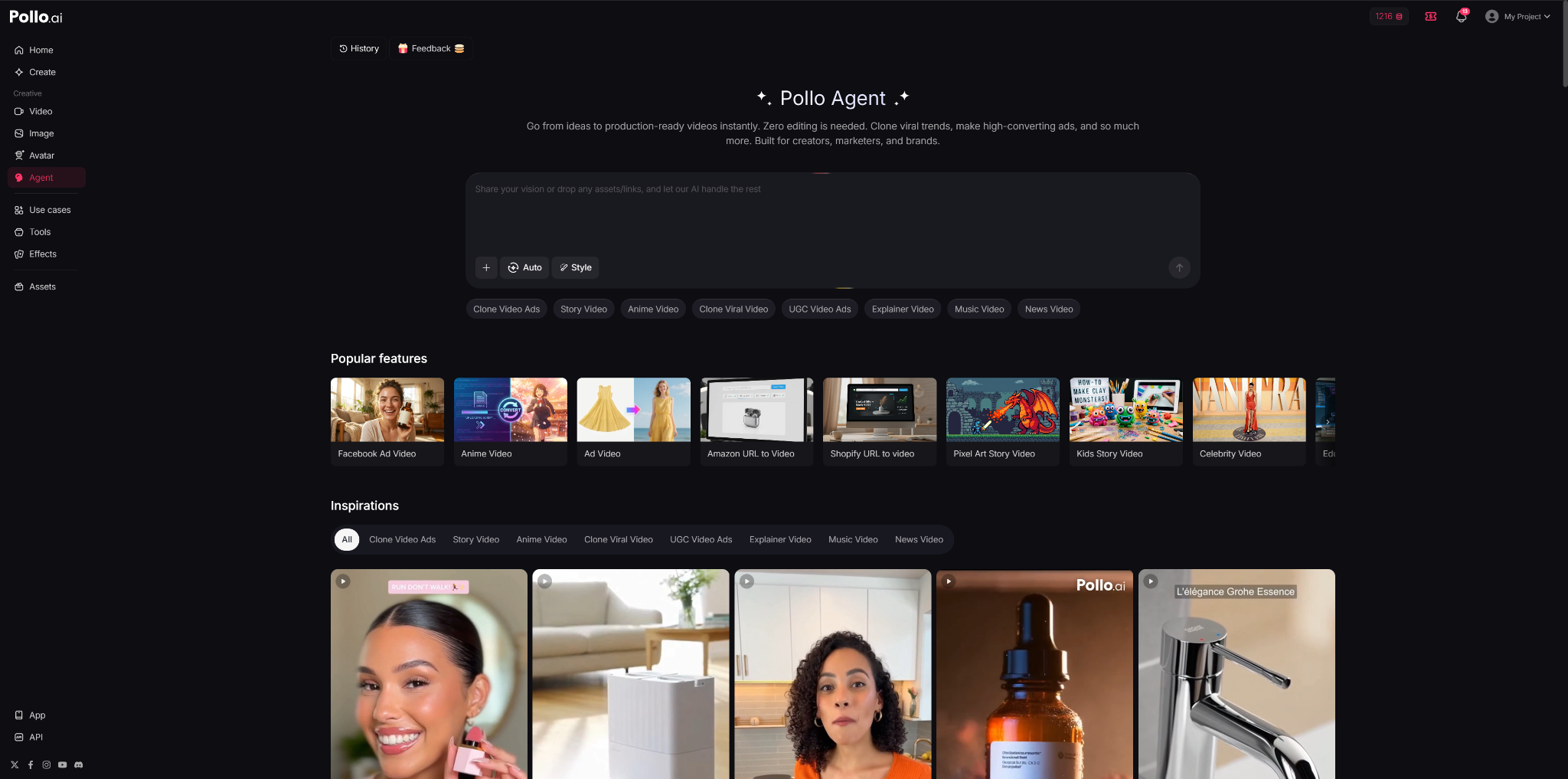
Pollo Agent is designed as an end-to-end AI video agent that transforms ideas, links, or assets directly into production-ready videos with minimal manual intervention. It is positioned as a workflow automation system rather than a traditional editor or generator. Instead of requiring users to build scenes manually or stitch clips together, Pollo Agent interprets input context and generates complete video outputs in a cohesive structure. Its functional scope includes viral video cloning, UGC ads, explainer videos, anime-style videos, product promotions, and social media content variations.
The platform integrates multiple advanced models such as Veo 3.1, Seedance 2.0, and others, dynamically selecting the most suitable model for each task. A key feature is its ability to accept TikTok or YouTube links and deconstruct them into underlying patterns such as hook structure, pacing, and narrative rhythm. This allows users to recreate or remix viral content without manually analyzing trends. The system also supports structured workflows for Facebook ads, Amazon product videos, Shopify URL-to-video generation, and multi-format social content production.
Why Pollo Agent stands out in real-world production workflows
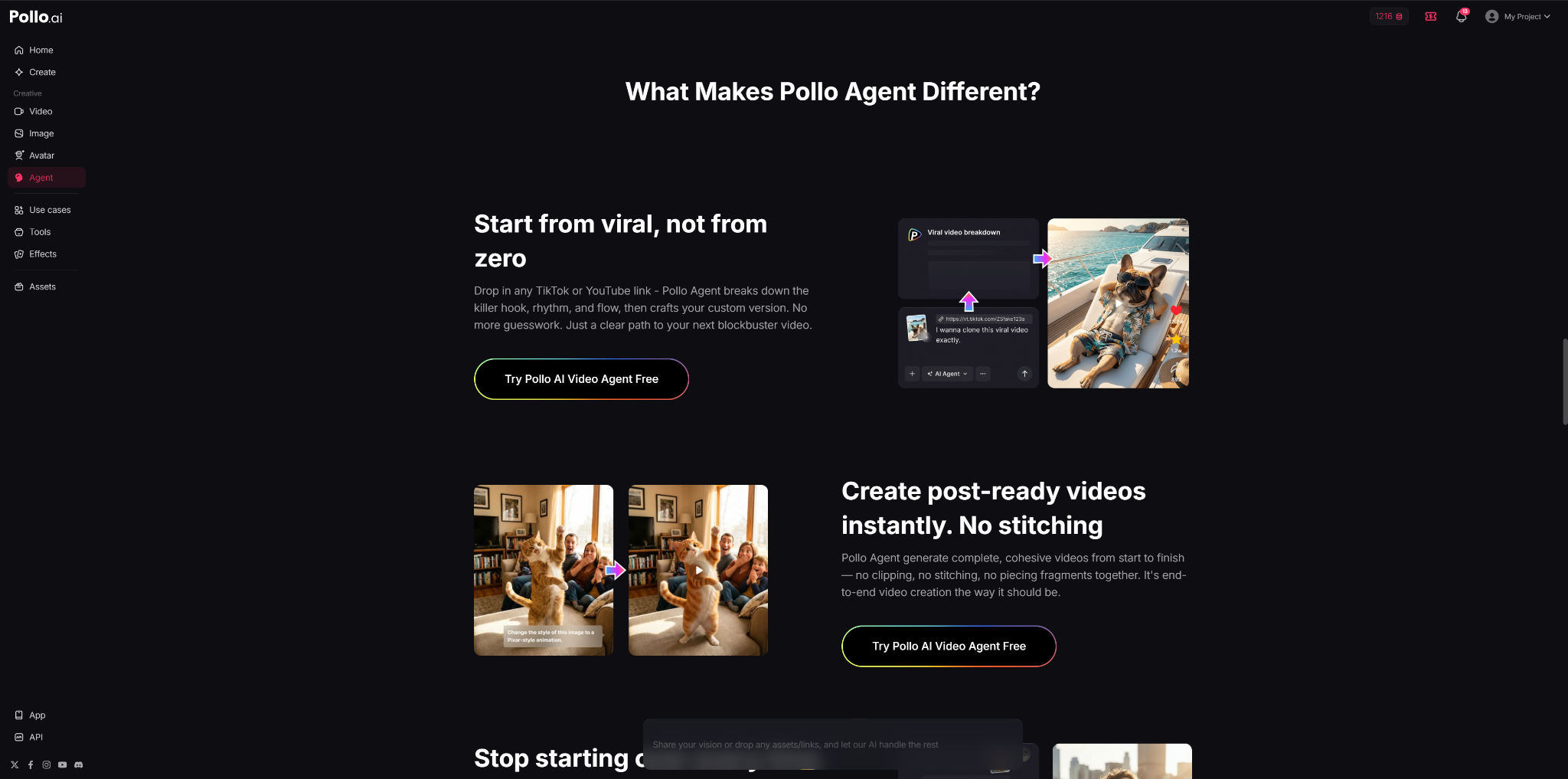
Pollo Agent stands out because it is designed around continuous production rather than isolated generation tasks. As an AI video agent, it maintains context across iterations, allowing users to refine outputs without restarting from scratch. This reduces friction in creative workflows where multiple variations of the same concept are needed, such as ad testing, social media scaling, or even building a consistent YouTube outro maker workflow for branded channel endings. The system’s ability to track visual direction and user preferences makes it suitable for iterative marketing campaigns and performance-driven content production.
In practical use cases, Pollo Agent is widely applicable to short video creators, e-commerce teams, and marketing departments. Creators benefit from its ability to convert trends into personalized content quickly, while businesses use it to generate batch marketing assets and test multiple advertising angles. It is particularly effective for platforms like TikTok, Instagram, Facebook ads, and product landing pages, as well as streamlined YouTube outro maker content for channels that require consistent end screens and subscription prompts. The removal of prompt engineering complexity also makes it accessible to users without technical expertise, allowing ideas to be converted into structured videos through conversational input.
Adobe Firefly
Adobe Firefly functions as an AI video agent embedded within Adobe’s broader Creative Cloud ecosystem, rather than a standalone video generation platform. It is primarily integrated into professional tools such as Premiere Pro, After Effects, and Photoshop, where it enhances traditional editing workflows with generative capabilities. The platform focuses on assisting creators with asset generation, scene enhancement, text-to-video features, and visual effect automation, rather than fully autonomous video creation.
Its positioning is closely aligned with enterprise and professional users who require controlled creative environments. Adobe Firefly provides generative tools that assist in producing video elements such as transitions, backgrounds, and visual extensions while maintaining compatibility with existing editing pipelines. It is designed to complement human-led editing rather than replace it, ensuring that creative direction remains under user control.
Why Adobe Firefly is strong in professional creative environments
Adobe Firefly stands out because it integrates AI capabilities into established professional workflows instead of replacing them. As an AI video agent, it enhances productivity for editors who already rely on Adobe software, reducing repetitive tasks such as asset creation and visual cleanup. This makes it particularly valuable for studios, agencies, and enterprise teams where brand consistency and precision are critical.
The platform is especially suitable for long-form video production, advertising agencies, and corporate media departments. It supports structured workflows where AI-generated elements are refined through manual editing, ensuring high levels of control and compliance. While it is less automated than newer agent-first systems, its strength lies in reliability, ecosystem integration, and professional-grade output consistency.
Canva Magic Studio
Canva Magic Studio operates as a simplified AI video agent focused on accessibility and rapid content creation. It is built on Canva’s existing design ecosystem, which emphasizes templates, drag-and-drop editing, and cross-format content creation. The AI layer enhances this system by enabling automatic video generation, layout suggestions, and content adaptation for different platforms such as Instagram, TikTok, and presentations.
The platform is designed for non-technical users who need to produce visually structured content without deep editing knowledge. It supports quick video assembly from text prompts, images, or templates, making it useful for educators, small businesses, and content marketers. While it does not offer deep cinematic control, it provides a streamlined experience for producing polished videos quickly.
Why Canva Magic Studio is effective for fast content production
Canva Magic Studio stands out because it prioritizes speed and usability over complexity. As an AI video agent, it allows users to generate usable video content in minutes through structured templates and automated layout systems. This makes it especially effective for teams that need consistent output across multiple channels without investing in professional editing resources.
It is widely used for social media posts, educational content, internal communications, and lightweight marketing materials. Its strength lies in reducing production barriers, enabling users to focus on messaging rather than technical editing. However, its reliance on templates can limit creative uniqueness, making it better suited for standardized content rather than highly customized video production.
CapCut AI Creative Suite
CapCut AI Creative Suite functions as a mobile-first AI video agent optimized for short-form and social media video production. It is closely aligned with platforms such as TikTok, where fast-paced editing, trending effects, and automated captioning are essential. The AI system supports tasks such as auto-cutting clips, generating subtitles, detecting scenes, and applying trend-based templates.
The platform is designed for creators who prioritize speed and virality over detailed manual editing. Users can upload raw footage or input prompts, and the system automatically generates structured short videos optimized for engagement. Its workflow is centered around rapid iteration, making it suitable for daily content creation.
Why CapCut AI Creative Suite is popular among short-form creators
CapCut stands out because it is deeply optimized for social media content cycles. As an AI video agent, it reduces the technical complexity of editing while aligning outputs with trending formats and platform requirements. This makes it especially effective for influencers, content creators, and marketing teams focused on TikTok, Instagram Reels, and YouTube Shorts.
Its primary advantage lies in automation of repetitive editing tasks such as trimming, syncing, and caption generation. This significantly reduces production time while maintaining platform-native output quality. However, its reliance on templates and trend-driven structures can limit originality, making it more suitable for fast content iteration than long-form storytelling.
InVideo AI
InVideo AI, through its Agent One system, operates as a prompt-driven AI video agent that converts text instructions into structured video outputs. It focuses on automating the entire production pipeline, including scripting, visual selection, narration, and sequencing. This allows users to generate complete video drafts from simple prompts without requiring manual editing.
The platform is primarily aimed at marketers, educators, and solo creators who need fast content generation. It supports explainer videos, promotional content, and informational videos that can be produced and edited within a unified interface. The system emphasizes structured automation while still allowing post-generation refinement.
Why InVideo AI Agent One is useful for rapid content generation
InVideo AI stands out because it balances automation with user control. As an AI video agent, it generates usable first drafts quickly, reducing the time required for scripting and assembly. This makes it particularly useful for users who need to produce large volumes of informational or marketing videos.
It is commonly used for educational explainers, product marketing, and digital storytelling. Its strength lies in transforming text into structured visual narratives, although its output quality is highly dependent on prompt clarity. While not as workflow-integrated as Pollo Agent, it remains effective for straightforward, prompt-based video creation needs.
Conclusion
The AI video agent category is increasingly defined by the balance between automation depth and creative control. Pollo Agent leads in workflow orchestration and viral content adaptation, while Adobe Firefly focuses on professional integration, Canva emphasizes accessibility, CapCut prioritizes short-form speed, and InVideo AI specializes in prompt-driven automation.
Together, these platforms illustrate how AI is reshaping video production into a more structured, agent-driven process. As capabilities continue to expand, the distinction between editing tools and autonomous video systems is likely to become even less defined, with AI video agents playing a central role in future content creation pipelines.